
Basal Cell Carcinoma Treatment: Symptoms, Diagnosis and What to Expect
Noticing a mark on your skin that won't heal is worrying. However, basal cell carcinoma is also one of the most treatable skin cancers. This is especially true when it's caught early. This guide explains basal cell carcinoma treatment, along with the symptoms and diagnosis process. It reflects the approach we follow at Apex Skin Clinic in Maidenhead, Berkshire.
At Apex, a consultant leads every skin cancer diagnosis and treatment plan. You will never be seen by a junior clinician working unsupervised. Below is a clear, practical overview of basal cell carcinoma, how it's diagnosed, and what treatment usually involves.
What Is Basal Cell Carcinoma?
Basal cell carcinoma, often shortened to BCC, is the most common skin cancer in the UK. Specifically, it develops in the basal cells of the outer skin's deepest layer. In most cases, long-term sun exposure is the trigger.
BCC tends to grow slowly. It also rarely spreads to other parts of the body. This makes it different from other types of skin cancer, such as melanoma, which can spread more quickly. Even so, BCC should never be ignored. Left untreated, it can still grow into surrounding tissue.
What Causes Basal Cell Carcinoma?
The main cause of basal cell carcinoma is cumulative exposure to ultraviolet (UV) light. This exposure can come from the sun or from sunbeds. As a result, BCC most often appears on areas that get regular sun exposure. These include the face, ears, scalp, neck, and hands.
Risk Factors to Be Aware Of
Several factors increase your risk of developing BCC. Fair or pale skin that burns easily is one. A history of frequent sun exposure or sunburn is another. Regular sunbed use and a weakened immune system also raise the risk. So do a previous BCC diagnosis, prior radiotherapy, and increasing age. If several of these apply to you, regular skin checks are a sensible precaution.
Recognising the Signs and Symptoms
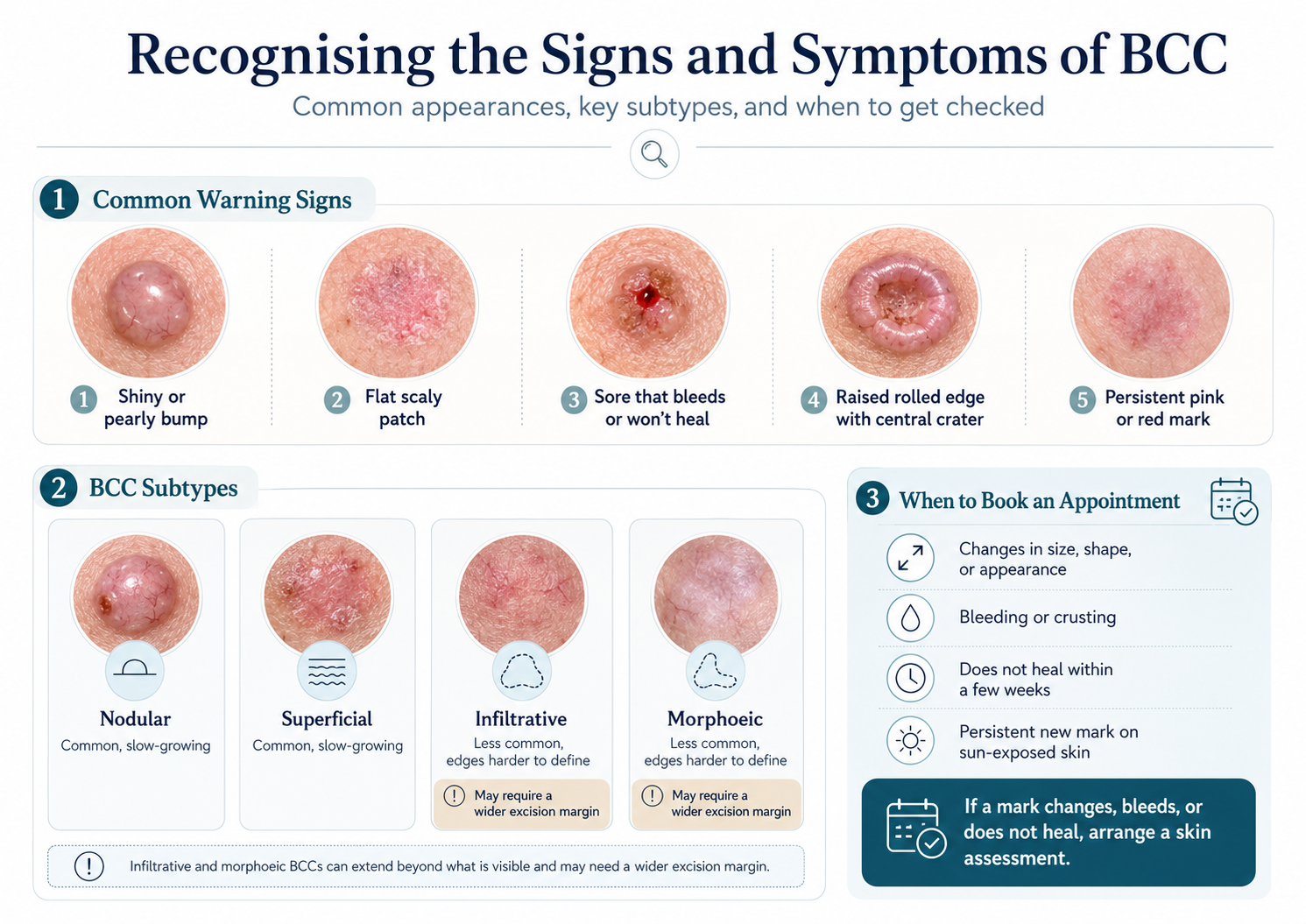
BCC can look different from one person to the next. Even so, some patterns are common. For example, watch for a shiny or pearly bump, or a flat scaly patch that doesn't clear up. A sore that bleeds and never fully heals is another warning sign. For instance, some lesions develop a raised, rolled edge around a central crater. Others appear simply as a persistent pink or red mark.
There are also different subtypes of BCC. Nodular and superficial BCCs are the most common, and they tend to grow slowly. Infiltrative or morphoeic BCCs are less common. However, they grow in a way that makes the edges harder to define. Because of this, they generally need a wider excision margin.
If you notice any mark that changes, bleeds, or fails to heal within a few weeks, book an appointment. Our guide to the early signs of skin cancer covers this in more detail.
Getting a Diagnosis
Basal cell carcinoma treatment always starts with an accurate diagnosis. At your screening and diagnosis appointment, your consultant will examine the lesion closely. They will also use dermoscopy, a technique that magnifies the skin's surface.
In most cases, this clinical examination is enough to reach a working diagnosis. Even so, your consultant will often take a biopsy first. This confirms the exact BCC subtype before treatment planning begins. Results are typically available within one to two weeks. Mole mapping can also help track any other lesions of concern alongside your BCC assessment.
Basal Cell Carcinoma Treatment Options at Apex Skin Clinic
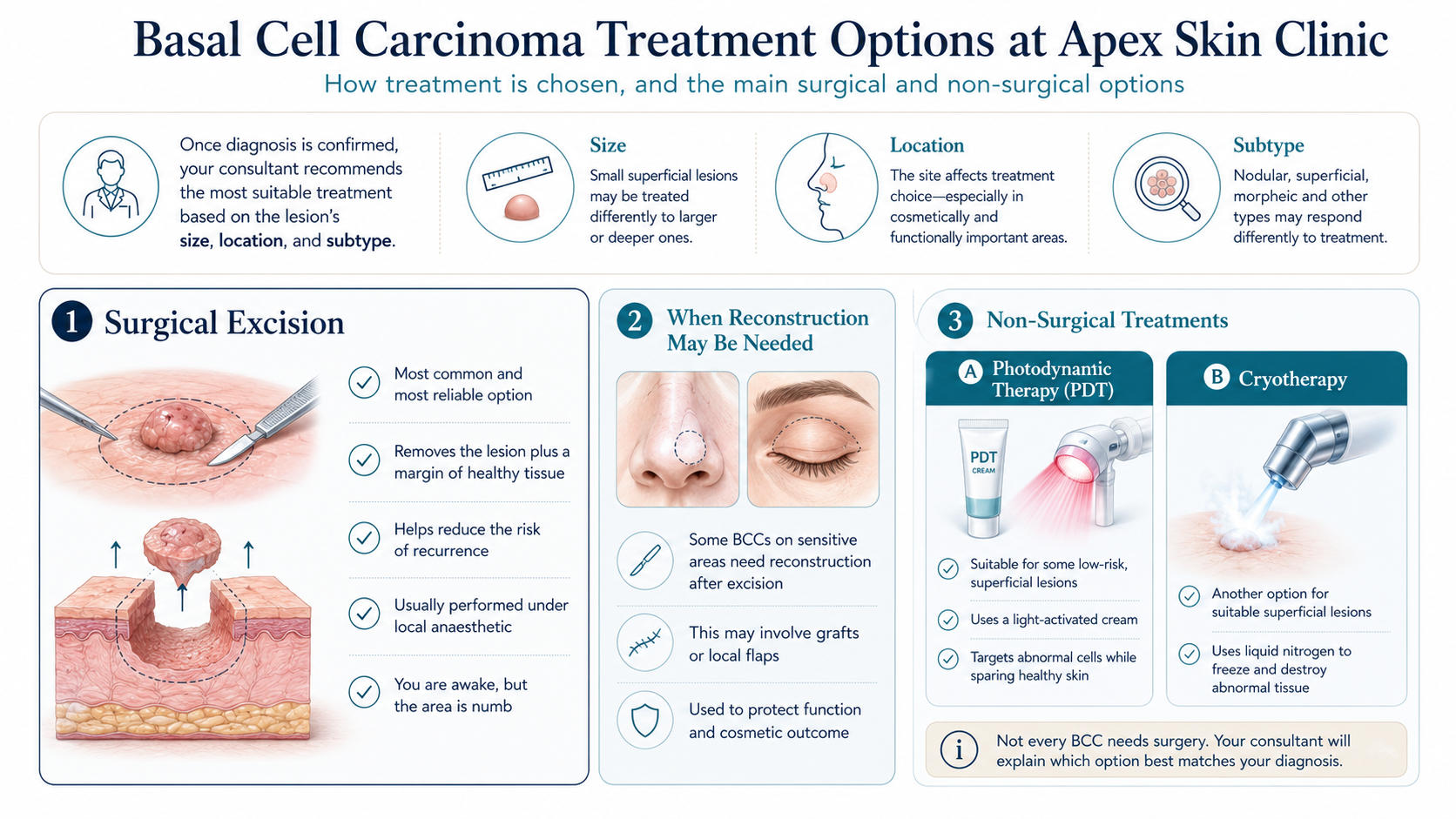
Once your diagnosis is confirmed, your consultant will recommend a treatment. This depends on the size, location, and subtype of your BCC. Most patients have one of the following options.
Surgical Excision
Excision is the most common and most reliable BCC treatment. It involves removing the lesion along with a margin of healthy tissue. This reduces the risk of the cancer returning. Typically, surgeons carry this out under local anaesthetic, so you'll be awake but completely numb.
For BCCs on sensitive areas, such as the nose or eyelids, reconstruction may follow. Our Treatments & Surgery page covers grafts and flaps in more detail.
Non-Surgical Treatments
Not every BCC needs surgery. For certain low-risk, superficial lesions, photodynamic therapy is a strong option. In practice, it uses a light-activated cream to destroy abnormal cells while sparing healthy skin. Cryotherapy is another non-surgical choice for suitable cases. It uses liquid nitrogen to freeze and remove the lesion. Your consultant will explain which treatment best matches your diagnosis.
What Happens After Treatment?
Overall, recovery depends on the treatment you have. Minor excisions usually allow a return to normal activities within a few days. Larger procedures involving reconstruction take longer to heal.
Apex Skin Clinic provides structured aftercare and monitoring for every patient. This includes wound checks and suture removal where needed. We also confirm that your lab results show clear margins. People who have had one BCC have a higher chance of developing another. For this reason, we recommend ongoing skin checks as part of your long-term care.
Is Basal Cell Carcinoma Dangerous?
Understandably, many patients worry that any skin cancer diagnosis is life-threatening. For BCC, the outlook is generally reassuring. It very rarely spreads to other organs, and it is highly curable when treated properly. That said, an untreated BCC can still grow into surrounding skin, muscle, or even bone. This is why prompt treatment matters, even for a slow-growing cancer.
Why Choose a Private Clinic for Basal Cell Carcinoma Treatment?
Choosing private basal cell carcinoma treatment means faster access to a named consultant. It also means a plan built entirely around you. At Apex Skin Clinic, we see most patients within days of their initial enquiry, rather than after weeks of waiting.
The clinic operates from Berkshire Grove Hospital in Maidenhead. Specifically, this is a fully equipped private hospital with an on-site surgical suite and histopathology services. Patients travel to Apex from Reading, Windsor, Bracknell, London, and across the South East for consultant-led skin cancer care.
Frequently Asked Questions
Does basal cell carcinoma spread to other parts of the body?
This is very uncommon. BCC almost always stays local to where it first develops. Because of this, it's considered one of the least dangerous skin cancers. Even so, it can damage nearby tissue if it isn't treated.
Is basal cell carcinoma the same as melanoma?
No. BCC and melanoma are different skin cancers with different risks. Melanoma is more likely to spread, so it's generally treated more urgently. BCC, in contrast, grows slowly and rarely spreads. Both still need assessment by a specialist.
Will I need surgery for basal cell carcinoma?
Not always. Many BCCs are best treated with excision, since it offers the most reliable outcome. However, some superficial lesions respond well to photodynamic therapy or cryotherapy instead. Your consultant will discuss the best option for your lesion.
Can basal cell carcinoma come back after treatment?
It can, particularly if you've had one before. Lesions with less well-defined edges also carry a higher risk of recurrence. This is why follow-up appointments and regular skin checks matter so much.
Do I need a GP referral to be seen at Apex Skin Clinic?
No. You can self-refer and book a private consultation directly, without a GP letter. That said, we're also happy to accept referrals if your GP has recommended us.
Book a Basal Cell Carcinoma Consultation at Apex Skin Clinic
If you've noticed a persistent mark, sore, or lump on your skin, don't wait. Early basal cell carcinoma treatment is simpler and faster. It's also more likely to avoid the need for reconstruction. Contact our team today to arrange a consultation with a consultant plastic surgeon or dermatologist.
You may also find our guide to what happens during skin cancer surgery useful. Alternatively, if you're not sure what to look for, read our guide to the early signs of skin cancer.
This article is for informational purposes only and does not constitute medical advice. If you are concerned about a skin change, please consult a qualified medical professional.
Apex Skin Clinic