
What Happens During Skin Cancer Surgery at a Private Clinic?
Being told you need surgery for skin cancer is understandably worrying. Questions about what the procedure involves, how long it takes, whether you will be awake, and what recovery looks like are all completely normal. This guide walks you through what to expect from skin cancer surgery at a private clinic, using the treatment options available at Apex Skin Clinic in Maidenhead, Berkshire as the reference point.
At Apex, all skin cancer treatments and surgery are led by consultant plastic surgeons and dermatologists with specialist skin cancer expertise. You will never be seen by a junior clinician working unsupervised. Here is a clear, honest overview of what the process looks like from diagnosis through to recovery.
Before Surgery: Getting a Diagnosis First
Surgery only happens once a diagnosis has been confirmed. If you have a suspicious mole, lesion, or skin change, the first step is a screening and diagnosis appointment where your consultant will carry out a clinical examination, dermoscopy, and where needed, a biopsy. A biopsy involves removing a small sample of tissue under local anaesthetic for laboratory analysis. Results are typically available within one to two weeks.
Once your type of skin cancer has been confirmed, your consultant will explain the recommended treatment. For most basal cell carcinomas (BCC), squamous cell carcinomas (SCC), and melanomas, surgical excision is the primary treatment. For some early-stage or superficial lesions, non-surgical options may be appropriate.
Surgical Treatments: What Each Procedure Involves
Excision (Minor and Complex)
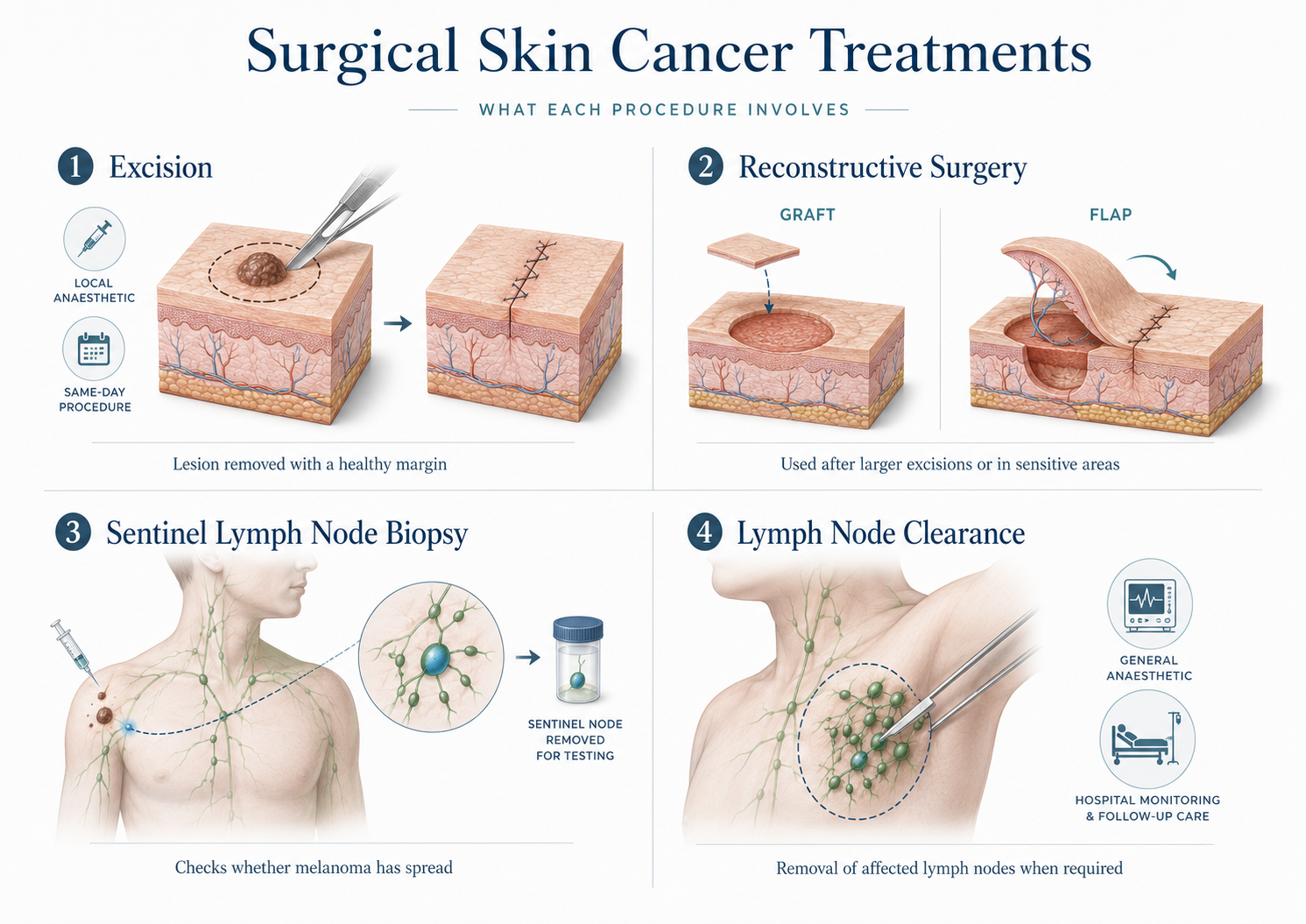
Excision is the most common skin cancer procedure. It involves removing the cancerous lesion along with a margin of healthy surrounding tissue to reduce the risk of the cancer returning. The margin size depends on the type and stage of the cancer.
For small, well-defined lesions, excision is carried out under local anaesthetic as a day procedure. You will be awake but the area will be completely numb. The wound is then closed with sutures, and most patients go home the same day.
For deeper or higher-risk cancers, a wider excision may be required, which means removing a larger margin of tissue. This is still usually performed under local anaesthetic unless the location or complexity of the lesion requires otherwise.
Reconstructive Surgery (Grafts and Flaps)
After a larger excision, or when a skin cancer is located on a cosmetically or functionally sensitive area such as the nose, eyelids, ears, or lips, reconstruction may be needed to close the wound and restore normal appearance and function.
A skin graft involves taking a thin layer of skin from another part of the body and placing it over the wound. A skin flap is a slightly more complex technique where nearby tissue is lifted and repositioned to cover the defect while keeping its blood supply intact. Flaps tend to heal well and produce better cosmetic results in visible areas.
Your surgeon will explain which approach is most appropriate for your situation before any procedure takes place.
Sentinel Lymph Node Biopsy
For some patients with melanoma, a sentinel lymph node biopsy is recommended to check whether cancer cells have spread to the nearest lymph nodes. This is an important staging tool that can guide further treatment decisions.
The procedure involves injecting a small amount of tracer dye near the tumour site to identify the sentinel node, which is the first lymph node the cancer is likely to have reached. That node is then removed and sent for laboratory analysis. If no cancer cells are found, no further lymph node surgery is typically needed.
Lymph Node Clearance
If a sentinel lymph node biopsy returns a positive result, or if lymph nodes are already visibly affected, surgical removal of the affected nodes may be required. This procedure is typically carried out under general anaesthetic and requires a period of post-operative monitoring and follow-up care.
Non-Surgical Treatments: When Surgery Is Not Required
Not all skin cancers require surgery. For certain early-stage or superficial lesions, non-surgical treatments can be highly effective and offer excellent cosmetic outcomes.
Photodynamic Therapy (PDT)
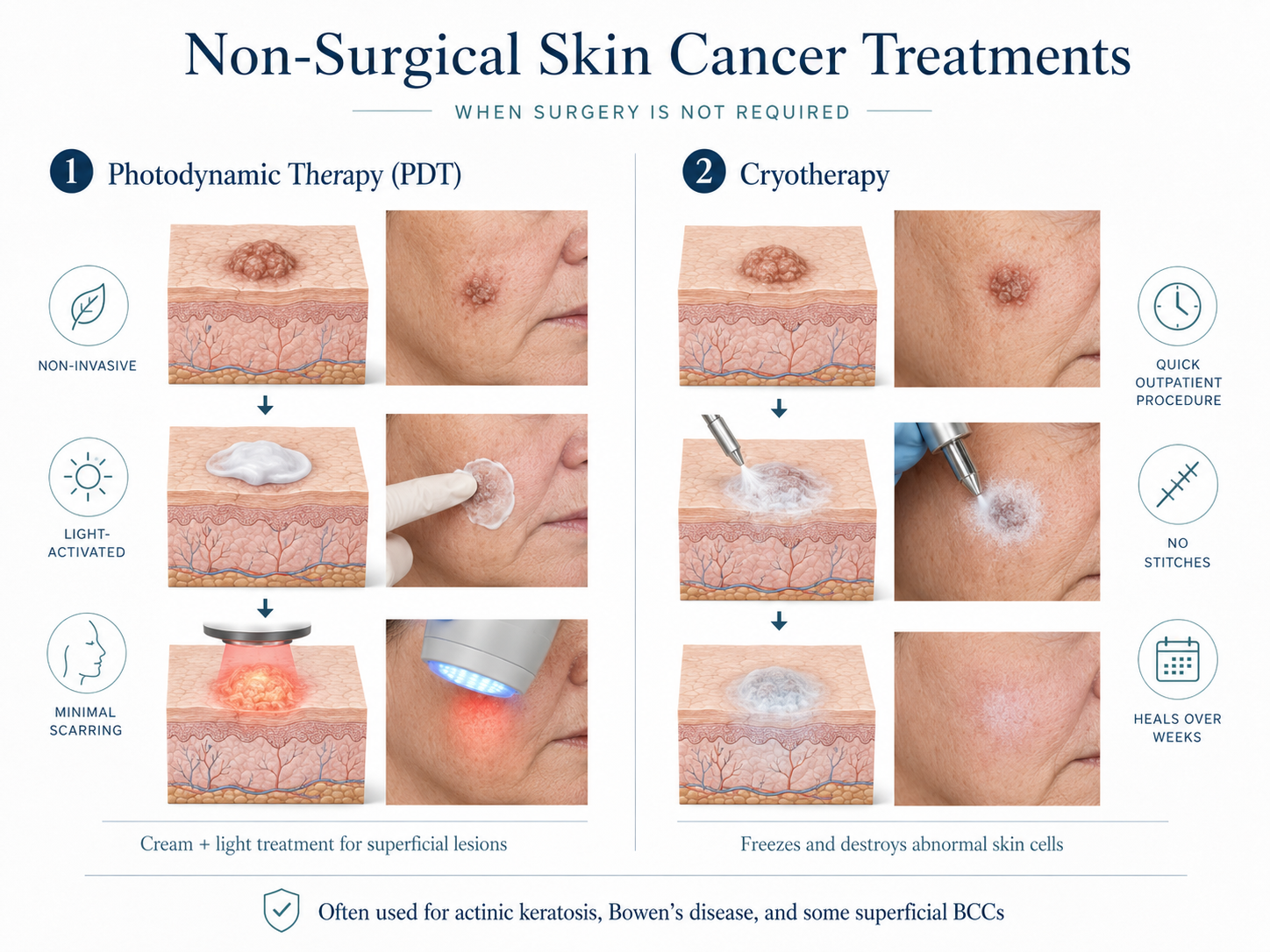
PDT is a non-invasive treatment that uses a special cream applied to the skin followed by exposure to a specific wavelength of light. The cream makes abnormal cells sensitive to light, which then destroys them while leaving healthy surrounding tissue largely unaffected.
PDT is particularly effective for actinic keratosis, Bowen's disease, and some superficial BCCs. It is well tolerated by most patients and leaves minimal scarring, making it a good option for lesions on the face or scalp where cosmetic results matter.
Cryotherapy
Cryotherapy uses liquid nitrogen to freeze and destroy abnormal skin cells. It is a quick, outpatient procedure that does not require incisions or stitches. It is commonly used for actinic keratosis, early Bowen's disease, and superficial BCCs.
The treated area will blister and crust over before healing, which typically takes a few weeks. Some temporary skin discolouration may occur but usually fades over time.
What Happens on the Day of Surgery?
For most procedures carried out under local anaesthetic, you can eat and drink normally beforehand and drive yourself home afterwards, though many patients prefer to bring someone with them for support.
On arrival at Apex Skin Clinic you will meet your surgical team, have the procedure explained again, and sign a consent form. The area to be treated will be cleaned and local anaesthetic injected to numb the skin completely. Most patients feel only mild pressure during the procedure rather than pain.
Depending on the complexity of the excision and any reconstruction required, the procedure itself typically takes between 30 minutes and 90 minutes. You will be given clear written aftercare instructions before you leave.
Recovery and Aftercare
Recovery varies depending on the type and extent of surgery. For minor excisions, most patients return to normal daily activities within a few days. More complex procedures involving reconstruction or lymph node surgery require a longer recovery period. Full details of what to expect will be given by your consultant and skin cancer nurse.
Apex Skin Clinic provides structured aftercare and monitoring for all surgical patients. This includes wound care, dressing changes, suture removal, and follow-up consultations to check healing and confirm clear margins from the laboratory. Long-term monitoring appointments are also scheduled for patients with a higher risk of recurrence.
Why Choose a Private Skin Cancer Clinic?
Choosing private skin cancer surgery means shorter waiting times, direct access to named consultant surgeons, and care that is coordinated entirely around you. At Apex Skin Clinic, most patients are seen within days of their initial enquiry rather than weeks or months.
The clinic operates from Berkshire Grove Hospital in Maidenhead, a fully equipped private hospital with an on-site surgical suite, histopathology services, and a dedicated skin cancer nurse team. Patients from across Berkshire, Surrey, London, Oxfordshire, and Sussex travel to Apex for treatment.
If you have been referred for skin cancer surgery by your GP, or if you have recently received a diagnosis and want to explore your options, our consultant team is here to help. You do not need a GP referral to book a private consultation at Apex.
Frequently Asked Questions
Will I be awake during skin cancer surgery? For most excisions and minor procedures, yes. Local anaesthetic is used to numb the area completely so you will not feel pain, but you will be awake throughout. General anaesthetic is only used for more complex procedures such as lymph node clearance.
How long does skin cancer surgery take? Most minor excisions take between 30 and 60 minutes. More complex procedures involving reconstruction or lymph node surgery may take longer. Your surgeon will give you a clear time estimate at your pre-operative consultation.
Will I have a scar after skin cancer surgery? Some scarring is inevitable after excision. Your surgeon will always aim to minimise scarring and will discuss the likely cosmetic outcome with you beforehand. Reconstructive techniques such as flaps and grafts are used specifically to improve the cosmetic result in visible or sensitive areas.
Can skin cancer come back after surgery? In most cases, complete surgical excision with clear margins results in a cure. However, some patients have a higher risk of recurrence or developing new skin cancers, which is why ongoing monitoring is an important part of care. Your consultant will recommend an appropriate follow-up schedule.
Do I need a GP referral to be seen at Apex Skin Clinic? No. You can self-refer and book a private consultation directly without a GP letter, though we can also accept referrals if your GP has recommended us.
Book a Skin Cancer Consultation at Apex Skin Clinic
If you have been diagnosed with skin cancer, are waiting for biopsy results, or have a mole or lesion you are concerned about, contact our team today to arrange a consultation. We see patients from Maidenhead, Reading, Windsor, Bracknell, London, and across the South East. Fast access, expert care, and a clear plan from your very first appointment.
You may also find our guide to FotoFinder mole mapping useful if you are considering a full body skin check before booking a surgical consultation.
This article is for informational purposes only and does not constitute medical advice. If you are concerned about a skin change, please consult a qualified medical professional.
Apex Skin Clinic