
What Are the Early Signs of Skin Cancer to Look For?
Skin cancer is one of the most common cancers in the UK, but when caught early it is also one of the most treatable. Knowing what to look for on your skin can make a significant difference to outcomes. This guide explains the key early warning signs to be aware of and when to seek a professional opinion.
Why Early Detection Matters
The earlier skin cancer is identified, the more treatment options are available and the better the likely outcome. Many skin cancers develop slowly and may be present for months or even years before causing symptoms. Regular self-examination and professional skin checks are the most effective tools for catching changes before they progress.
The ABCDE Rule for Checking Moles
The ABCDE rule is a simple and widely used method for assessing whether a mole or pigmented lesion may need further investigation.
Asymmetry One half of the mole does not match the other. Normal moles tend to be symmetrical in shape.
Border The edges of the mole are irregular, ragged, notched, or blurred rather than smooth and well-defined.
Colour The mole has more than one colour or shade, including different shades of brown, black, red, white, or blue within the same lesion.
Diameter The mole is larger than 6mm across, roughly the size of a pencil eraser. However, some melanomas can be smaller than this, particularly in the early stages.
Evolution The mole has changed in size, shape, colour, or texture over weeks or months, or has started to bleed, itch, or crust.
Any mole that ticks one or more of these boxes should be assessed by a specialist.
Other Early Warning Signs to Watch For
Skin cancer does not always present as a changing mole. There are several other signs worth being aware of:
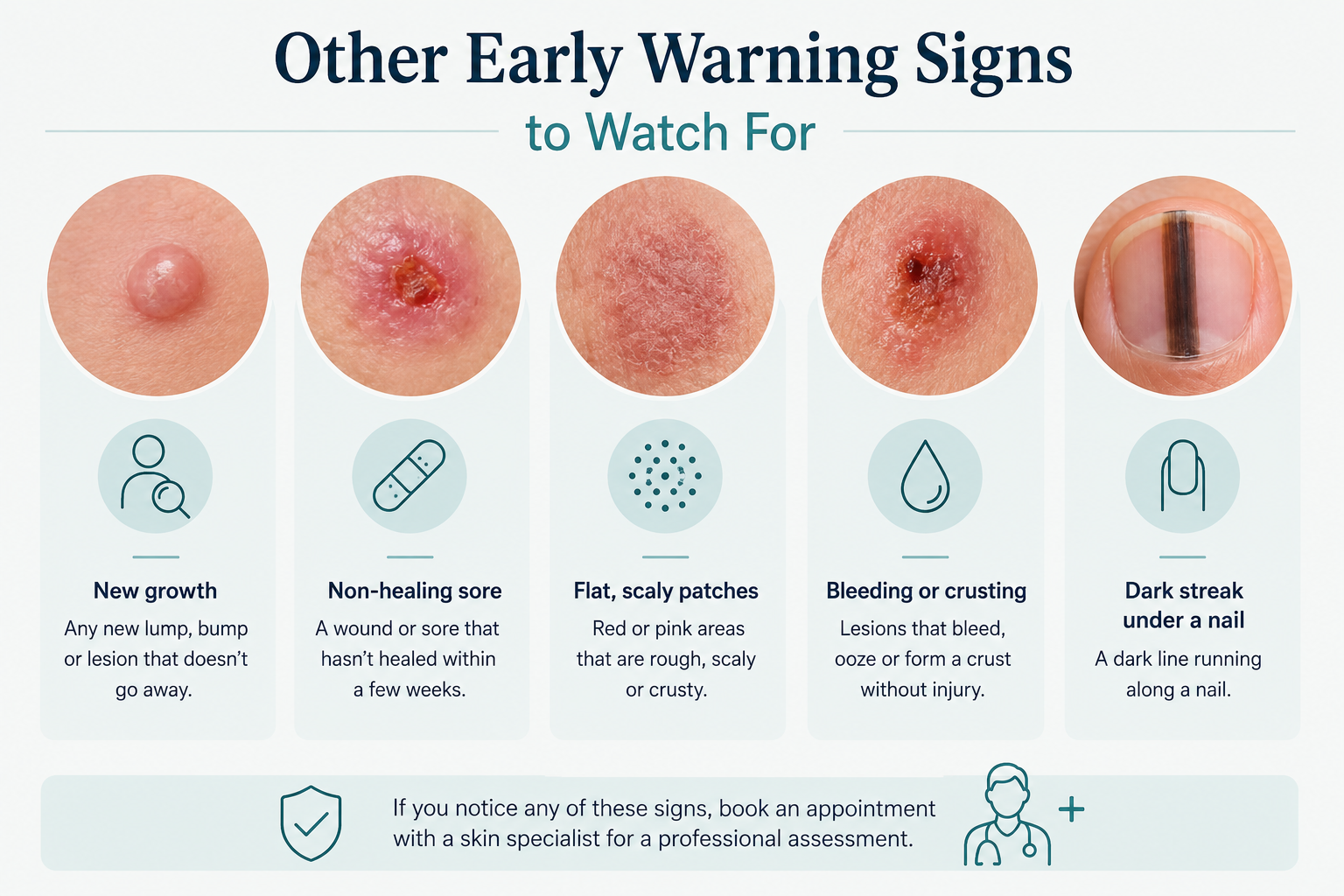
A new or unusual growth Any new lump, bump, or lesion that appears on the skin and does not resolve within a few weeks should be checked, particularly if it is pearly, waxy, or skin-coloured.
A sore that does not heal A wound, ulcer, or sore that fails to heal after four weeks is a recognised warning sign of certain types of skin cancer, including basal cell carcinoma.
A flat, scaly patch Red or pink flat patches that are rough or scaly to the touch may indicate actinic keratosis, a precancerous condition, or early squamous cell carcinoma.
Bleeding or crusting without injury A spot or lesion that bleeds, oozes, or forms a crust without having been injured warrants prompt professional assessment.
A dark streak under a nail A dark brown or black streak running the length of a fingernail or toenail can occasionally indicate subungual melanoma, a less common but serious form of skin cancer.
Who Is Most at Risk?
While skin cancer can affect anyone, certain factors increase your risk:
Fair skin, light hair, and light eyes
A history of sunburn, particularly in childhood
Frequent or prolonged sun exposure
Use of sunbeds
A large number of moles or atypical moles
A personal or family history of skin cancer
A weakened immune system
Being aware of your risk factors can help you make informed decisions about how often to have your skin checked professionally.
When to See a Specialist
If you have noticed a change to an existing mole, a new growth, or any of the signs described above, it is important not to wait. A GP can offer an initial assessment, but a consultant dermatologist or skin cancer specialist will have the clinical expertise and diagnostic tools to provide a thorough evaluation.
At Apex Skin Clinic, our consultants use advanced dermoscopy and FotoFinder mole mapping technology to assess the skin with precision, identifying changes that may not be visible to the naked eye. Early assessment gives you clarity and, where treatment is needed, the best possible chance of a straightforward outcome. If you are concerned about a mole or skin change, book a consultation with our team in Berkshire.
Frequently Asked Questions
Can skin cancer appear anywhere on the body?
Yes. While skin cancer most commonly develops on areas frequently exposed to the sun such as the face, neck, hands, and arms, it can appear anywhere on the body including areas that rarely see sunlight. Regular full-body checks are recommended for those at higher risk.
Is a changing mole always cancer?
Not necessarily. Many moles change slightly over time without being cancerous. However, any noticeable change in size, shape, colour, or texture should be assessed by a specialist to rule out anything concerning.
How often should I check my skin?
Self-examination once a month is a good habit to develop. Professional skin checks are recommended annually for those with multiple moles, a history of sunburn, or other risk factors. A full body mole mapping appointment provides the most comprehensive baseline assessment.
What is the difference between a mole check and mole mapping?
A mole check involves a visual examination of individual moles of concern. Mole mapping uses specialist camera technology to photograph and digitally record every mole on the body, allowing precise comparison over time to detect any changes. Read more about mole mapping at Apex Skin Clinic.
Can skin cancer be cured if caught early?
In many cases, yes. Basal cell carcinoma and squamous cell carcinoma detected at an early stage are highly treatable, often through straightforward surgical removal. Early-stage melanoma also has excellent survival rates when treated promptly.
This article is for informational purposes only and does not constitute medical advice. If you are concerned about a skin change, please consult a qualified medical professional.
Apex Skin Clinic